What Is CR80 Card Size? The Complete Guide to Standard Plastic Card Dimensions
Posted by Jocelyn Silverman on Apr 14th 2026

If you've ever ordered blank plastic cards, ID cards, or gift cards, you've almost certainly come across the term "CR80." It's the industry-standard size for plastic cards — the same dimensions as a credit card — and understanding it can save you time, money, and the frustration of ordering cards that don't fit your printer or cardholders.
This guide covers everything you need to know about CR80: what it means, its exact dimensions, why it became the standard, how it compares to other card sizes, and how to choose the right card for your needs.
What Does CR80 Mean?
CR80 is an industry designation for the standard credit card size. The "CR" stands for credit card, and "80" refers to the card's sequential classification in the ISO/IEC 7810 international standard for identification cards.
The ISO 7810 standard defines several card sizes used across banking, government, and commercial applications. CR80 (also called ID-1 in the ISO standard) is by far the most widely used format worldwide.
CR80 Dimensions
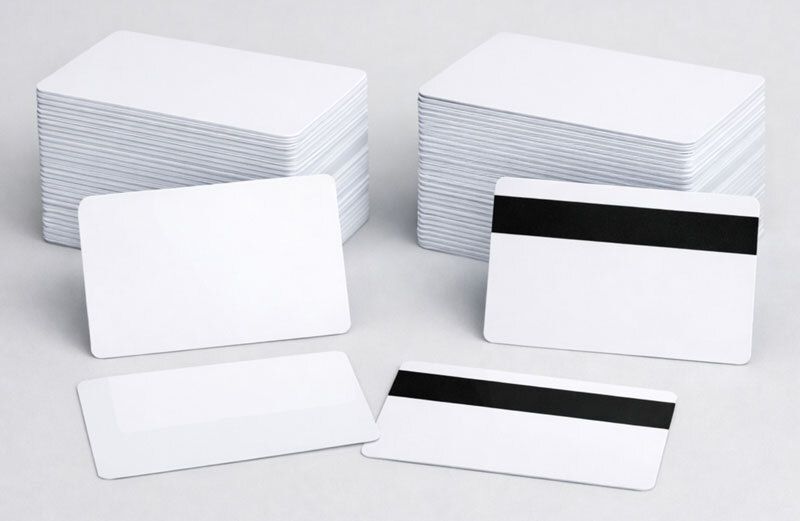
A CR80 card measures:
- 3.375 inches × 2.125 inches (imperial)
- 85.6 mm × 54 mm (metric)
- Standard thickness: 30 mil (0.030 inches / 0.76 mm)
These dimensions are identical to a standard credit card, debit card, or driver's license — which is exactly why the format became universal. If it fits in a wallet slot, it's almost certainly CR80.
Quick Reference
|
Measurement |
Imperial |
Metric |
|
Width |
3.375 in |
85.6 mm |
|
Height |
2.125 in |
54.0 mm |
|
Standard thickness |
0.030 in (30 mil) |
0.76 mm |
|
Corner radius |
0.125 in |
3.18 mm |
What is "mil" thickness? In the card industry, "mil" refers to one-thousandth of an inch — not millimeters. A 30 mil card is 0.030 inches thick. This is the standard thickness for most PVC cards.
Why CR80 Became the Universal Standard
The CR80/ID-1 format was codified by the International Organization for Standardization (ISO) to ensure that cards from different manufacturers and different countries could work with the same readers, printers, and wallet slots around the world.
Before standardization, card sizes varied widely. Financial institutions, governments, and businesses needed a single format so that magnetic stripe readers, chip readers, and card printers could be manufactured to consistent tolerances. The CR80/ID-1 size won out because it struck the right balance: large enough to hold readable text, barcodes, photos, and magnetic stripes, yet small enough to fit in a standard wallet.
Today, virtually every card printer on the market — from Zebra to Fargo to Evolis — is designed around the CR80 format as the default input size.
Common Uses for CR80 Cards
Because CR80 is the universal plastic card size, it's used across virtually every industry and application:
Business and Retail
- Gift cards
- Loyalty and rewards cards
- Membership cards
- Discount cards
- VIP cards
Identification and Access
- Employee ID badges
- Student ID cards
- Hotel key cards
- Access control cards
- Visitor badges
Healthcare and Government
- Insurance cards
- Library cards
- Government-issued ID
- Patient identification cards
Events and Hospitality
- Event passes
- Season tickets
- Casino player cards
- Gym membership cards
CR80 vs. Other Card Sizes
While CR80 is the dominant format, a few other standard sizes exist for specific use cases. Here's how they compare:
|
Format |
ISO Name |
Dimensions |
Common Use |
|
CR80 |
ID-1 |
3.375" × 2.125" |
Credit cards, ID cards, gift cards |
|
Business Card |
3.5” x 2” |
Business cards (U.S. Standard) |
|
|
CR79 |
— |
3.303" × 2.051" |
Adhesive-back cards (slightly smaller to overlay on proximity cards) |
|
CR100 |
— |
3.88" × 2.63" |
Larger ID badges, some healthcare applications |
|
CR90 |
ID-2 |
4.134" × 2.913" |
European driver's licenses, some ID programs |
|
CR80 Key Tag |
— |
1.375" × 2.625" |
Keychain loyalty cards, mini member tags |
|
3-Up Key Tag |
— |
Three key tags per CR80 sheet |
Breakaway key tags printed on a full card |
CR79 is worth knowing about if you use proximity (prox) cards for access control. CR79 cards are slightly smaller than CR80 so they can be printed and then adhered directly over an existing prox card without adding extra bulk.
CR80 Card Thickness Options
While 30 mil (0.76 mm) is the standard thickness for CR80 cards, thinner and thicker options exist for specific applications:
|
Thickness |
Common Use |
|
30 mil |
Standard ID cards, gift cards, loyalty cards, most card printers |
|
20 mil |
Lighter applications, some inkjet-compatible cards |
|
10 mil |
Adhesive-back cards, overlays, key tag overlays |
|
40 - 50 mil |
Thicker cards for upscale use like golf and country clubs - not compatible with all card printers |
For most card printers — including popular models from Zebra, Fargo, Magicard, and Evolis — 30 mil is the recommended default. Always check your printer's specifications before ordering a different thickness, as some printers have strict tolerances.
CR80 Card Materials
CR80 cards are available in several materials depending on your printing method and application:
PVC (Polyvinyl Chloride) — The most common material. Durable, flexible, and compatible with virtually all card printers. Standard 100% PVC cards work well for most applications.
Engineered Paper — A newer, more eco-friendly option that mimics the feel of plastic while being constructed from recycled paper fiber. Ideal for gift cards and loyalty programs where brands want to reduce plastic waste without sacrificing the card-in-wallet experience. These are not compatible with most thermal plastic card printers.
Polycarbonate — Used for high-security government and government-grade ID cards. Much harder to alter or counterfeit than PVC.
What to Look for When Buying Blank CR80 Cards
If you're purchasing blank CR80 cards to print in-house, here's what to check:
- Printer compatibility — Most card printers specify which card stock they're tested and approved for. Using off-spec cards can cause print quality issues or damage the printhead.
- Thickness — Confirm 30 mil unless your printer manual specifies otherwise.
- Coercivity (for magnetic stripe cards) — If your cards have a magnetic stripe, you'll need to choose between HiCo (high coercivity, 2750 Oe) and LoCo (low coercivity, 300 Oe). HiCo stripes are harder to accidentally erase and are used for most access control and ID applications. LoCo stripes are typically used for gift cards or single-use applications.
- Surface finish — Glossy surfaces produce more vivid colors and photographic-quality prints. Matte finishes reduce glare and fingerprinting, which can be useful for cards that are handled frequently.
- Card stock quality — Inconsistent thickness, dust, or burrs on card edges can cause card jams and printhead wear. Buying from a reputable manufacturer ensures consistent tolerances.
Frequently Asked Questions
Is CR80 the same size as a credit card? Yes. CR80 cards measure 3.375" × 2.125", which is exactly the same as a standard Visa, Mastercard, or debit card. This is intentional — the format was standardized so that all plastic cards in the financial and ID industries share a common size.
Is CR80 the same size as a business card? No. CR80 cards measure 3.375" × 2.125", while a standard business card measures 3.5” x 2”.
Will CR80 cards fit standard cardholders and badge holders? Yes. Any badge holder or cardholder labeled for "credit card size" or "ID card size" will fit a CR80 card.
Do all card printers use CR80? The vast majority of desktop card printers — including all major consumer and business-grade models — are designed for CR80 as the primary card size. Some industrial printers support multiple sizes, but CR80 is always supported.
What's the difference between CR80 and ISO 7810 ID-1? They're the same thing. CR80 is the industry trade name; ID-1 is the ISO standard designation. Both refer to the 3.375" × 2.125" card format.
Can I print on both sides of a CR80 card? Yes, if your card printer supports duplex (two-sided) printing. Most mid-range and above card printers include a duplex module or option. Without a duplexer, you’ll simply need to flip the cards over and reload.
Summary
CR80 is the universal standard for plastic cards — 3.375" × 2.125" at 30 mil thick — used for everything from credit cards and gift cards to employee badges and hotel keys. It's the size your card printer expects by default, the size that fits every wallet slot and badge holder, and the format that every major card printing manufacturer builds around.
When you're buying blank plastic cards for in-house printing, CR80 30 mil PVC is almost always the right starting point. From there, your choice of color, magnetic stripe, RFID, and material depends on your specific application.
Looking for blank CR80 cards? BlankPlasticCards.com offers the largest selection of blank PVC cards in North America — white, colored, metallic, fluorescent, and magnetic stripe — manufactured in the USA and shipped direct. Shop all blank plastic cards
Prefer to order printed CR80 cards? Print Robot offers printed plastic business cards, membership cards, gift cards, ID cards, RFID cards, and paper cards. Shop printed cards